
Where do I start with AI automation in my business?
"We want to automate. Where do we begin?"
It is the most common question we hear. And it is a good one, because starting in the right place makes everything that comes after it easier. Starting in the wrong place is expensive, demoralising and puts people off the idea for a long time.
Here is the framework we use with every business we work with.
Start with pain, not potential
The most common mistake businesses make when starting their AI automation journey is trying to find the most exciting opportunity rather than the most obvious one.
The right starting point is almost always the most painful, repetitive, high-volume manual process in your business. Not the most strategic one. Not the most impressive one when you describe it to someone at a conference. The one that makes the person doing it want to throw their computer out the window.
High-volume repetitive tasks have a clear ROI calculation. They are easy to scope. They produce visible, measurable results quickly. And a quick win builds the internal confidence and executive support you need to do the harder, more ambitious work later.
How to find it
Ask yourself or your team one question: what do we do every day, or every week, that a reasonably intelligent person could do with no judgement at all if you gave them a clear enough set of instructions?
That is your AI automation target. Common answers we hear from Australian businesses: manually keying invoices into an accounting system, copying data from one system to another, chasing approvals that sit in someone's inbox, matching purchase orders to invoices line by line, processing timesheets and calculating pay.
Prioritise by value and complexity together
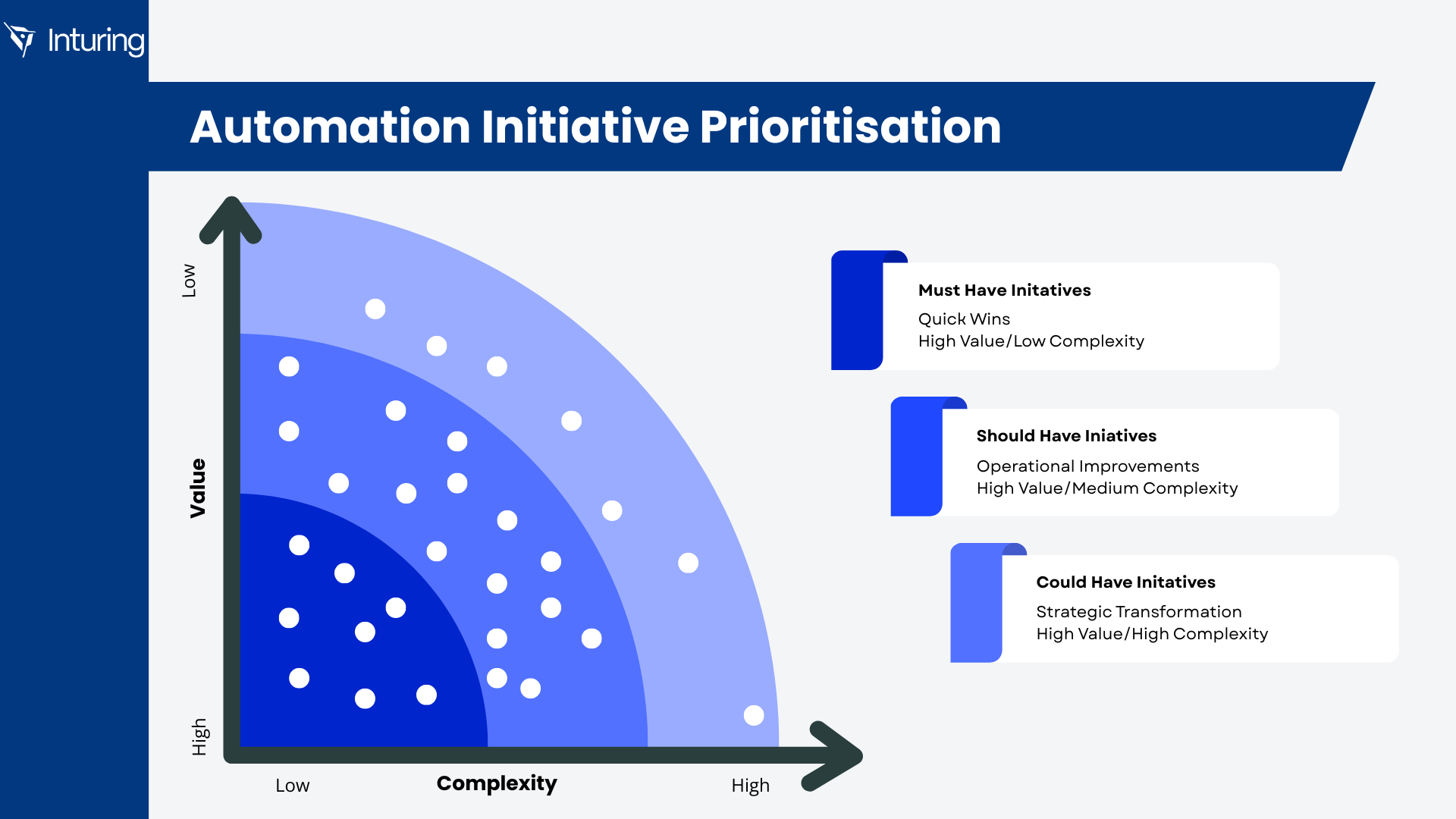
Once you have a list of candidates, map them against two axes: value and complexity. Value is the time saved, the error rate reduced, or the cost avoided if this process were automated. Complexity is how hard it would be to build.
The sweet spot is high value and low complexity. That is your first project. Scope it tightly, build it quickly, prove it in production and then use it as the business case for the next one.
Start with one module, not a platform
When businesses first engage with AI automation, there is a temptation to solve everything at once. The better approach is one module: one process, one trigger, one outcome. Get that working in production. Learn from it. Use what you learn to scope the next one better.
Every project we run starts with a single, scoped module. The businesses that end up with the most sophisticated AI automation environments got there one module at a time.
The simplest summary
Find the most painful repetitive process your business does. Map it against value and complexity. Pick the high-value, low-complexity version. Scope it tightly. Build one module. Prove it works. Then do the next one.
If you want to work through this framework for your specific situation, we are happy to do that as a conversation before anything else.